Non functional requirements: error messages

This blog post is part of a series on non functional requirements, and how they take most of the effort.

The scenario

You want a third party to implement an application package to allow people to buy and sell widgets from their phone. Once the package has been developed, they will hand it over to you to sell, support, maintain and upgrade and you will be responsible for it,

At the back-end is a web server.

Requirements you have been given.

  • We expect this application package to be used by all the major banks in the world.
  • For the UK we expect the number of people who have an account to be about 10 million people
  • We expect about 1 million trades a day.
  • The banks want the messages from the web server to be in their national language, for example Japanese banks want the messages to come out in Japanese.

See start here for additional topics.

What standards do you need to specify for these web server messages?

Consider the following code to issue a database request

EXECUTE_SQL(returnCode,ReasonCode, “SELECT FROM…”, pReturnedData,&length)

Where

  • return code is 0, 4, 8,12 or 16
    • 0 all worked
    • 4 is warning, perhaps no records found
    • 8 is error, perhaps invalid table specified
    • 12 is severe error – you do not have access to the table
    • 16 critical or terminating – major problem so bad the system is shutting down
  • Reason code. This gives an error specific code which allows you to identify the warning or error, there may be thousand of these
  • “SELECT FROM…” is the string passed to the database
  • pReturnedData is where the returned data is stored
  • &length is the length of the buffer on input, and is set to the length of the data on return.

You could have some code to report the error.

if (rc != 0)
{
printf("Hey Dude, Database error!");
return (rc);
}

This is wrong in so many ways.

  • It provides very little useful information.
  • It does not report the return and reason code, which you need to identify the problem
  • You do not know which source module reported this message
  • It is hard to look up on the internet to see if this problem has been reported before.
  • It does not display the message in the National Language. Adding code If language=Japanese printf(….) is not practical – as the message content is embedded with in the program source.
  • If you have 10,000 transactions hitting these problem you will get flooded with messages, and it will be hard to see any other messages.

What can you do?

Rather than put the printf inline, call a message function, and pass the variable data. This message function looks up the message boilerplate and substitutes the variables. Different languages are handled by having a different file of messages.

In IBM on the mainframe there are standards for messages.

  • Each product is allocated a 3 digit character string prefix. This is used in the source code names, for messages etc. By looking at the first three characters of a message, I know which product it came from.
  • The next character is for the major component within the product. xxxC… may be the command processor, xxxS… may be for the statistics component.
  • Then comes a 3 or 4 digit number.
  • The last character is I, W,E,S,T to represent Information, Warning, Error, Serious error, Terminating error. With this scheme you can have automation which ignores ‘I’ and ‘W’ messages, and only takes action for ‘E’, ‘S’ and ‘T’. For example if you get a ‘T’ message then page someone.

You may want to reuse the same message – for example you issue the data base request in 100 source files. Or you use a macro to generate the code. It makes sense to use the same error message number, but you need to provide something to identify which of the 100 source files, and which of the several instance within one source file.

You could give the source file name, but this may give away confidential information about your product structure. Instead, you could give each source file a number. You combine the source file identifier with the line number in the file. You then report it as a hex code ‘00050028’ so this would be for module ‘5’ line 40 (0x28).

Your code then calls a function

MSG_MODULE('ABCD1234W',0x00050028,rc,reason,pString); 

Where pString points to useful information like the table name which caused the error.

In your msg_module, if the language is English, you locate the external constant ABCD1234W in the English file, if the language is Japanese you locate the external constant ABCD1234W in the Japanese file.

This string may be something like

“ABCD123W Database problem. Return code %1$d, Reason code %2$d, location %3$8.8x, table %4$s”

Where

  • %1$d says covert the first parameter to a decimal
  • %2$d says convert the second parameter to a decimal
  • %3$8.8x says convert the third parameter to a hexadecimal number
  • %4$s says treat the 4th parameter as a string.

You should use %1$d instead of %d because the parameters may be displayed in a different order, such as

“ABCD123W Il y a une database problem avec table %4$s. Return code %1$d, Reason code %2$d, location %3$8.8x”

What information is useful?

You need to decide where to produce the information, for the end user, or the operators.

For operators

For each message you need to decide what information is useful. A message such as

“ABCS555E Security violation”

Could be improved by adding the userid causing the violation, and what resource was being accessed, the time the event occurred and the server instance.

For the end user

With security messages you need to be careful not to give information away to people breaking into your system. A message

Userid or password invalid

is better than

Password invalid

because the second message tells the hacker the userid chosen is valid, it is just the password which is wrong. With Userid or password is invalid you do not know if the userid is invalid, or the password is invalid, or both are invalid.

Make it searchable on the internet

If people get an error message, they will look in the documentation or search the internet. If someone enters the message number, and the inserts, they should be able to find any references to this, perhaps in user groups. If you have messages in different languages, such as English and Japanese, you should just need the message number and inserts. The message text may be helpful, but not needed.

You need to be careful to be consistent in the user of decimal numbers and hex numbers. Some people may treat 16 as decimal 16, and others may treat it as 0x16 or decimal 22.

How to stop a flood of messages

If you are running 1000 transactions a second, and there is a database problem you will get at least 1000 messages reporting the database problem.

You might want to do some processing to summarise information. For example, display a message. If the same message is quickly produced, then do not display it, but accumulate the count of messages, then report

FLOOD MESSAGE. 404 instance in the last minute of “ABCD1234E Database problem return code 8, reason code 144 identifier 003304AB”

FLOOD MESSAGE. 19 instance in the last minute of “ABCE333S Database contact lost problem return code 12, reason code 26 identifier 0033025C”

Provide useful information

You should provide one messages for each unique problem or situation, and list the actions to take to resolve any problems. As your product gets used, you may find there are more causes for each problem, and so you need to update the messages to reflect this. I think it would be great to allow users to vote on solutions, so if there are 3 solutions listed, one has 100 votes, one has 2 votes and the other has no votes, then try the popular solution first.

For each message you need to provide

  • A longer description of the message
  • What the system action was (did it do anything like close a database)
  • What the end user/administrator should do

For example the real message

CSQ9016E ‘cmd‘ command request not authorized

This page give which product and which component. It is an Error message.

The message has sections for

  • Explanation
  • System action
  • System programmer response

Another example

  • CSQ5007E csect-name RRSAF function function failed for plan plan-name, RC=return-code reason=reason syncpoint code=sync-code
  • Explanation :A non-zero or unexpected return code was returned from an RRSAF request. The Db2 plan involved was plan-name.
  • System action: If the error occurs during queue manager startup or reconnect processing, the queue manager might terminate with completion code X’6C6′ and reason code X’00F50016′. Otherwise, an error message is issued and processing is retried.
  • System programmer response: Determine the cause of the error using the RRS return and reason code from the message. See Db2 codes in the Db2 for z/OS documentation for an explanation of the codes and attempt to resolve the problem.
Non functional requirements: documentation

This blog post is part of a series on non functional requirements, and how the NFR take most of the effort.

The scenario

You want a third party to implement an application package to allow people to buy and sell widgets from their phone. Once the package has been developed, they will hand it over to you to sell, support, maintain and upgrade and you will be responsible for it,

At the back-end is a web server.

Requirements you have been given.

  • We expect this application package to be used by all the major banks in the world.
  • For the UK we expect the number of people who have an account to be about 10 million people
  • We expect about 1 million trades a day.

See start here for additional topics.

A word of wisdom

A wise person said – never assume , always state the obvious, because what is obvious to you may not be obvious to them.

Of course you want documentation provided by the development team. How hard is it to specify what you need?

The first “obvious” thing is you want soft copy of all documentation source and tools to be able to update and print new versions. “Provide documentation” could be interpreted as send you a print-out of the documentation, which you then photocopy – but cannot update or reprint.

The second obvious thing is that you want the documentation to be useful. Much of the documentation available for products, covers all you need to know – but not in a consumable format. For example with the instruction book for my new car, how to start the engine was on page 110!

With software you may get a book with all of the commands, or all of the APIS, in alphabetical order. When you are new to a product you often need just a few commands or APIs to get you started, and be able to evaluate the product. If you have a web page with the options for a particular command, it would be good to have a buttons called “first time”, “normal usage”, and “expert usage”. If you click on the “first time” button all of the optional or expert options are hidden.

Know your audience.

I worked with a product that had 150 pages of configuration instructions, before you could start the product. When you did start using it you often got an unhelpful message “Error in ££BOPEN file not set up properly”, and you were not told which file was not set up.

If you were an expert in the platform, and knew where to look, you could find additional information.

Customers reported many problems getting it going.

I worked with the developers and they rewrote the installation instructions. The first steps were to create a startable instance with no useful function. This took about 2 sides of paper. Once this started, we added in a component, and checked that it started, then add another component, and checked that started and so on. The users loved it, and the number of problems reported dropped significantly. If the product started; then you did more configuration and if it did not work, it was clear where to look – something you did in the last few pages.

We also provided good samples which could be used out of the box. These had instructions called “extending ….”

What is interesting to the user

if you provide web site for your documentation monitor which pages get hit, and which are not referenced. You can then review the popular pages, and perhaps update them.

If a particular message gets many hits. Enhance the “what to do now” section, or change the code to produce better diagnostics.

Non functional requirements: get the supported levels right

This blog post is part of a series on non functional requirements, and how the NFR take most of the effort.

The scenario

You want a third party to implement an application package to allow people to buy and sell widgets from their phone. Once the package has been developed, they will hand it over to you to sell, support, maintain and upgrade and you will be responsible for it,

At the back-end is a web server.

Requirements you have been given.

  • We expect this application package to be used by all the major banks in the world.
  • For the UK we expect the number of people who have an account to be about 10 million people
  • We expect about 1 million trades a day.

See start here for additional topics.

What does supported levels mean?

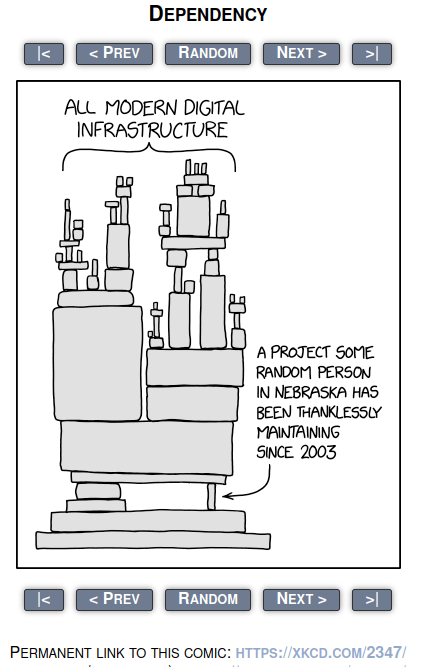
Your code may use code from other sources. If you experience problems with this code you want to be able to get assistance in diagnosing problems, and getting them to create fixes to any problems, in a timely manner(within a week, rather than within a year).

The following cartoon expresses this well.

You need to think about all code you use. You may use a package, which in turn uses an unsupported package. How are you going to know you are using this unsupported package, and how do you get support for it. This may affect your decision as to which packages you use. You may decide a perfect package should not be used, because it has a component which is not supported, and decide instead to use a not-so-good package which is supported.

Supported levels

The software used should be at supported levels. For example Java 7 went out of service many years ago. Java 21 was released in 2024.

If you are using unsupported code, and experience a problem, you may get no support, or have to pay a lot of money to get the support.

Over time you will need to create plans to upgrade the software used so that everyone has current software which is neither too new (let other people find the bugs) or too old (unsupported).

This will mean setting up test environments to test these new levels. You also need to plan on how you will get your customers to upgrade.

If you need to make code changes to support newer version, then you need to think about how you ship fixes to customers. You need to know which level the customer has, and send them the appropriate fix.

Document and test the requirements

You need to document what levels of packages are required, and what are supported. For example you may say that you support Java 18, 19, 20, and 21. You need to have these environments in your development, support and test systems, so you can recreate customer problems, and check that the supported environment still work.
This applies for remote databases where the database is not on same machine as your product.

Does your code need to checks it is running on supported levels. It can make problem diagnosis much easier if you know the customer is/is not running on supported levels of software.

Non functional requirements: what does your support team need?

This blog post is part of a series on non functional requirements, and how the NFR take most of the effort.

The scenario

You want a third party to implement an application package to allow people to buy and sell widgets from their phone. Once the package has been developed, they will hand it over to you to sell, support, maintain and upgrade and you will be responsible for it,

At the back-end is a web server.

Requirements you have been given.

  • We expect this application package to be used by all the major banks in the world.
  • For the UK we expect the number of people who have an account to be about 10 million people
  • We expect about 1 million trades a day.

See start here for additional topics.

Support structure

You will need to set up a support structure to handle questions and problems from your customers. The level of support covers

  • Answering general use questions – such as database usage, or web server configuration. This team will usually be people who speak the customer’s language. This is known as Level one, or first level.
  • Answering harder question and problems. These guys may have access to the source. They know the diagnostic tools available with the product. This is known as level 2, or second level
  • Debugging code problems. This may be just one team – but with people spread around the world who can work on the problem 24 *7. They may have customer-like test systems so they can try to reproduce the customer’s problems. This is known as level 3 or third level.
  • Write fixes. Once a problem has been identified, you need people to write fixes. A fix can have side effects so you may need to stop the customer problem from happening, but not give the correct solution (until a new version of your product). This team is known as the change team, or fix team.
  • Test fixes. This team works with the team that writes fixes.
    • the team reproduces the problem
    • applies the fix and checks the problem is resolved
    • packages the fix for customers
    • look at their existing tests to see why there were no existing tests to capture it, then enhancing the test cases to cover the holes found.

What do the support team need?

Level 2 and level 3 need access to, and knowledge of the tools available to debug problems. This may include

  • Messages on a log
  • Probe-ids or First Failure Data Capture
  • Traces
  • Dumps of storage. If there are hexadecimal dumps, you may need tools for format the data into control blocks, and fields within the control blocks.
    • Your tools may also have smarts to report unusual situations discovered, such “The value of field ErrorsDDetected in the control block CB1 for user MYUSERS is non zero”

The teams need guidance as to which traces to turn on when. For example turning on a system wide Java trace can double the CPU cost, half the throughput, and produce giga bytes of trace data.

You need commands to be able to turn on/off the trace without restarting your product.

If just one user gets a problem, can you turn on trace just for that user?

Can you turn on trace for a component, such as the database component?

Some customers will not allow trace to be enabled in production, because of the impact on CPU and throughput, and for data privacy issues. This means you need to provide debug facilities which are low cost, cannot be disabled and do not display any personal data.

What are the non functional requirements for the support teams?

  • Source for the product
    • in a source control system
    • with a build tool for all environments.
  • “Internal documentation” describing the components, and what each source module does.
  • Comments in the code for any non obvious code. For example describing what a function does.
  • Test system so any fixes can be validated in all environments.
    • Supporting different levels (or just the lowest) of the operation system.
    • Support of national language – so you have a web server configured for Japanese.
  • External facilities used by product (such as Java or database) are supported, current, and will be current for the next 12 months. You may have to pay for the support.
  • Internal defect database, so the support teams can search for previously seen, or similar problems.
  • All external components or dependencies are documented, and support plans agreed with the provider.

.

Non functional requirements: providing debug information.

This blog post is part of a series on non functional requirements, and how they take most of the effort.

The scenario

You want a third party to implement an application package to allow people to buy and sell widgets from their phone. Once the package has been developed, they will hand it over to you to sell, support, maintain and upgrade and you will be responsible for it,

At the back-end is a web server.

Requirements you have been given.

  • We expect this application package to be used by all the major banks in the world.
  • For the UK we expect the number of people who have an account to be about 10 million people
  • We expect about 1 million trades a day.

See start here for additional topics.

Why plan for debug information?

The web server will be installed in customer environments, to which you do not have access. If there is are problems the customer will expect you to diagnose the problem with the information the product provides.

If you turn the trace on for some products it uses up much more CPU, and this may be unacceptable to a customer ( Quote from an upset customer “Are you saying I have to buy a bigger server just to collect the trace!?!”)

Even with a low transaction rate of 100 a second, running with a verbose trace will be very expensive, and there will be a lot of it.

Some products write an entry and exit trace. You could be smart, do not create an entry trace, and only provide an exit trace if there is an unexpected or interesting condition. In this case you need to write the input parameters, and error codes, and enough information to be able to identify the problem. This might include an account number, a database table name etc.

You might want to write trace in a binary format and format it when needed – this saves the CPU used to format the data, but it is more work to write code to format the data.

Every unexpected return code from a function should be traced. If you are doing a database call, and it returns no record found – this may be expected, and so can be ignored. If you were doing a database update, and you get record not found – this is a problem.

To help with the flow through some code, you could consider footprints in storage. You have macro increments a counter, and sets on a bit in the storage. For example

bit debugInfo[60];
...

debugInfo[1] = 1;
if ()
{
debugInfo[2] = 1;
}
else
{
debugInfo[3] = 1;
}

if ( writing_trace_entry)
{
output debuginfo...
}

and you have a clue as to the path taken through the code.

With every trace entry provide the information needed to identify which source module, and which point within the source module. This could be module name, and line number, or combination of a number for the source (myprog.c has number 73) and the n’th trace macro instance.

You might want to be able to trace an individual user, such as account number… This has a much smaller impact to tracing all systems.

You might want trace a component, such as database, TLS, authentication etc.

Non functional requirements: standards

This blog post is part of a series on non functional requirements, and how they take most of the effort.

The scenario

You want a third party to implement an application package to allow people to buy and sell widgets from their phone. Once the package has been developed, they will hand it over to you to sell, support, maintain and upgrade and you will be responsible for it,

At the back-end is a web server.

Requirements you have been given.

  • We expect this application package to be used by all the major banks in the world.
  • For the UK we expect the number of people who have an account to be about 10 million people
  • We expect about 1 million trades a day.

See start here for additional topics.

What standards?

You may have industry standards you have to follow. You may have corporate standards you have to follow.

For a hardware device the standards could include the amount of radiation it generates (high frequency radio or microwaves) You need to specify how this will be tested.

You may have to worry about the amount of heat your solution will generate, and how much power it will consume.

Industry software standards may include

  1. Keeping an audit trail of transactions for 10 years
  2. Provide a right to forget, so you can permanently remove someone’s records from the system. This may be incompatible with 1) above. I didn’t say the standards are consistent.
    • How do your implement right to forget – you have backups taken 9 years ago. Are you going to restore all these backups, delete the records, create another backup and delete the original? This will not work.
  3. Report breaches of security.
    • A hacker has accessed your system
    • Some one in your organisation has looked at data without a need to know. For example someone looks up their child’s partner, to see if they are on the government/police computer. This means you need to provide the mechanism to protect and report violations, and an the ability to administer this authority.
  4. Maintain a list of people who had authority to a resource – but did not use it.

How will you test these standards are being met?

Non functional requirements: start here

I’ve been involved with a university, providing guest lectures on various computer topics. In conversation with the students, they thought that implementing the functional requirements took most of the effort. I disagreed, saying that the functional requirements took a small percentage of the effort, the effort was spent in the Non Functional Requirements.

The scenario

You want a third party to implement an application package to allow people to buy and sell widgets from their phone. Once the package has been developed, they will hand it over to you to sell, support, maintain and upgrade and you will be responsible for it,

At the back-end is a web server.

Requirements you have been given.

  • We expect this application package to be used by all the major banks in the world.
  • For the UK we expect the number of people who have an account to be about 10 million people
  • We expect about 1 million trades a day.

These series of posts cover my thoughts on some of the topics. I’ve tried to cover aspects which are not covered by generally available information.

First thoughts

I spent just a few minutes coming up with the list of Non Functional Requirements below.

  1. How do you provide 24* 7 availability – you are allowed 1 minute of outage in a year!  How do you do this, bearing in mind you need to reboot your machines once a month.
  2. Backups… how often do you backup your database? – how long do you keep your backups for ?   It might take 12 hours to backup your database (50 million records each of 10,000 bytes)    How do you do this and provide 24*7 availability, and database consistency.
  3. More important than backups – are you able to restore from a backup and recover your data?
  4. What monitoring do you provide – so when you get a twitter storm saying this product is slow – what does the product provide?  Is average response time good enough? (No)
  5. Our customers often want messages in English, Japanese etc.  How do you write your code to support this?
  6. Your product has a database problem – you are doing 10,000 transactions a second – so in 100 seconds you get 1 million messages in your log! How do you avoid the flood of messages.
  7. What protection do you want for your database – for example encryption of fields , who has access to fields?
    • Can people who provide the disks where you run your database, read your databases and other files.
    • If the disks/files are encrypted – who has access to the decryption keys?
    • Can people who are responsible for backing up your data, see the data in the database?
  8. What audits information do you need to provide – for example who changed what, when?  How long to keep this data for?  Do you keep access records of who looked at a record; think of the Police computers, should you as a policeman be able to access information about a high profile person, “just out of interest”.
  9. What test suites do you provide – for example you create a fix, and you need to regression test the whole of  your product.  (In one product I worked on the test suite was about 5 times larger than the base code!  It handled normal, error and edge cases).
  10. What debug coding standards do you have?  Think of the post office Horizon scandal.  At the end of the day there is a difference in the amount of money in, and out of £10,100.  How do you debug this and find the problem
  11. You need sensible error messages (so people can google them) with appropriate, helpful return codes.  What standards do you need to provide?
  12. What encryption are you going to use on connections?
  13. What headers are you going to provide in the HTML?
  14. How do you stress test your product?  One customer (a bank) ran their test workload at double the expected production workload.  Customer said that if the system was down – it cost them $10,000,000  a minute in fines and compensation.
  15. What levels of code, such as Java will be used.

Links to pages

wireshark not working across an x11 session

I tried to use wireshark using a remote logon to a system. This failed with

This application failed to start because no Qt platform plugin could be initialized. Reinstalling the application may fix this problem.

There was an easy fix.

ssh -X u350@10.1.0.5

Use the -X option – simple.

I also saw references to the file/etc/ssh/sshd_config on the remote machine and the file needing X11Forwarding yes

If you use the following in a command window

echo $DISPLAY

it should say something like

localhost:10.0

One minute networking: getting your data to flow around the corner; IP tunnelling

This is another of the little bits of networking knowledge, which, once you understand it, is obvious! Some of the documentation on the web is either wrong or is missing information.

The original problem

I wanted to use a route management protocol (OSPF) for managing the routing information known by each router. It has its own format packets. Not every device or router supports these packets.

You configure the interface name, and the OSPF data flows through the interface.

When the connection is a direct line, the data is passed to the remote system and it can use it. When the connection is indirect, for example via a wireless router. The wireless router does not know how to handle the OSPF packets and throws them away. The result is that my remote machine does not get the OSPF packets.

The solution – use a tunnel

One solution is to wrap the packets of data, so they get passed up to the router, round the corner, and back down to the remote system.

When I was employed, we had an internal mail system for paper correspondence . If we wanted to send a letter to a different site, we took the piece of internal mail, put it in an envelope and sent it through the national mail to the remote site. At the remote site, the mail room removed the external envelope, and sent the internal letter on to the recipient. It is a similar process with IP tunnelling.

I have a laptop with IP address A.B.C.D and a server with address W.X.Y.Z., I can ping from A.B.C.D to W.X.Y.Z, so there is an existing path between the machines.

You define a tunnel to W.X.Y.Z (the external envelope) and give which interface address on your system it should use. (Think of having two mail boxes for your letter, one for Royal Mail, another for FedEx).

You define a route so as to say to get to address p.q.r.s use tunnel ….

The definitions

The wireless interface for my laptop was 192.168.1.222 . The wireless address of my server was 192.168.1.230

I defined a tunnel from Laptop to Server called LS

sudo ip tunnel add LS mode gre local 192.168.1.222 remote 192.168.1.230 

Make it active and define the address on the server 192.168.3.3 .

sudo ip link set LS  up
sudo ip route add 192.168.3.3 dev LS

If I ping 192.168.3.3 the enveloped packet goes to the server machine 192.168.1.230 . If this address is defined on the server the ping sends a response – and the ping worked!

Except it didn’t quite. The packet got there, but the response did not get back to my laptop.

At the server the ping “from” IP address was 10.1.0.2, attached to my laptop’s Ethernet. This was not known on the server.

I had three choices

  • Define a tunnel back from the server to the laptop.
  • Use ping -I 192.168.1.222 192.168.3.3 which says send the ping request to 192.168.1.1 , and set the originator address to 192.168.1.222. The server knows how to route to this address.
  • Define a route from the server back to my laptop.

The simplest option was to use ping -I … because no additional definitions are required.

This does not solve my problem

To get OSPF data from the server to my laptop, I need a tunnel from the server to my laptop; so a tunnel each way

Different sorts of data are used in an IP network

  • IPV6 and IPV4 – different network addressing schemes
  • unicast and multi cast.
    • Unicast – Have one destination address, for example ping, or ftp
    • Multicast – Often used by routers and switches. A router can send a multicast broadcast to all nodes on the local network for example ‘does any nodes have IP address a.b.c.d?‘. The data is cast to multiple nodes.

When I defined the tunnel above I initially specified mode ipip. There are different types of tunnel mode ipip is just one. The list includes

  • ipip – Virtual tunnel interface IPv4 over IPv4 can send unicast traffic, not multi cast
  • sit – Virtual tunnel interface IPv6 over IPv4.
  • ip6tnl – Virtual tunnel interface IPv4 or IPv6 over IPv6.
  • gre – Virtual tunnel interface GRE over IPv4. This supports IPv6 and IPv4, unicast and multicast.
  • ip6gre – Virtual tunnel interface GRE over IPv6. This supports IPv6 and IPv4, unicast and multicast.

The mode ipip did not work for the OSPF data.

I guess that the best protocol is gre.

Setting up a gre tunnel

You may need to load the gre functionality

sudo modprobe ip_gred
lsmod | grep gre

create your tunnel

sudo ip tunnel add GRE mode grep local 192.168.1.222 remote 192.168.1.230 
sudo ip link set GRE up
sudo ip route add 192.168.3.3 dev GRE

and you will a matching definition with the same mode at the remote end.

Displaying the tunnel

The command

ip link show dev AB 

gives information like

9: AB@NONE: mtu 1476 qdisc noqueue state UNKNOWN mode DEFAULT group default qlen 1000 link/gre 192.168.1.222 peer 192.168.1.230

where

  • link/gre this was defined using mode gre
  • 192.168.1.222 the local interface to be used to send the traffic
  • peer 192.168.1.230 the IP address for the far end

The command

ip route 

gave me

192.168.3.3 dev AB scope link

so we can see it gets routed over link(tunnel AB).

Using the tunnel

I could use the tunnel name in my defintions, for example for OSPF

interface AB
area 0.0.0.0

How to reduce the chance of screwing up in a Linux window.

I had multiple Linux terminal windows open, doing SSH to different machines. I typed shutdown in the wrong window – and the wrong server shutdown!

I had configured different profiles so I could have a white background, a green background and a yellow background for my different systems, but I had got careless and not used them.

I found a neat way of colouring the windows automatically.

xdotool is a command-line X11 automation tool, which allows you to programmatically press keys. You can use this to set the profile of a terminal window.

To create a profile

From the hamburger options,

  • preferences,
  • profiles +
  • give the profile a name, create
  • select the named profile, it will display customising options
  • colours
  • untick Use colours from system theme
  • Click Text or Background
  • Pick a colour, Select
  • Close the window

Select a profile

Manually

  1. From the hamburger option
    • Select Profile
    • Pick a profile
  2. or Shift+f10
    • r (for Profile)
    • 3 for the third option in the list

Programmatically

xdotool key shift+F10 r 3

This does Shift+10, then select r for Profile, then picks the 3rd option

The clever bit

You can make an alias such as

alias somehost="xdotool key shift+F10 r 3; ssh user@somehost; xdotool key shift+F10 r 2"

or a somehost.sh script

#!/bin/sh
xdotool key shift+F10 r 3
ssh me@10.1.0.5
xdotool key shift+F10 r 2

If you enter the somehost command – it will select the 3rd profile, do the ssh. On exit from ssh it resets it back to the 2nd profile.